
Research seminar Machine learning Data analysis
- Date: May 22, 2026
- Duration: 33:30
- Speakers: Garri Proshyan, St. Petersburg Department of the Steklov Mathematical Institute
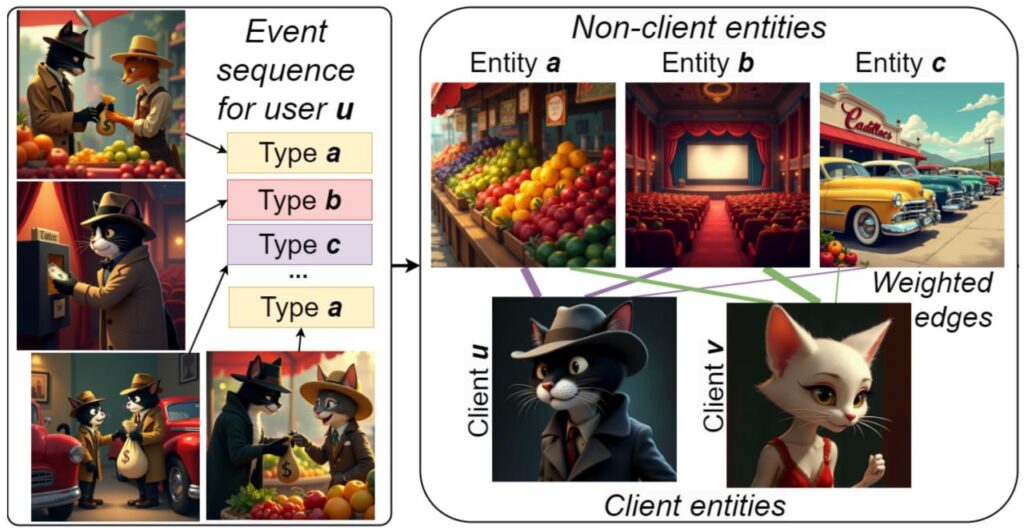
Effective fraud detection, credit scoring, and user targeting require accurate and expressive user embeddings capable of predicting customer attributes and behavior. A standard approach is to use self-supervised learning (SSL) models that construct a representation vector for each user based on their individual transaction history or event logs. However, this approach has a significant limitation: by treating customers in isolation, it ignores the global graph structure of interactions between them. This talk explores how to address this blind spot.
We propose three model-agnostic methods for incorporating graph structure into sequential SSL models. GrEmb initializes representations of non-customer entities using GNN-based embeddings. Reg introduces a CLIP-style alignment objective that regularizes user representations obtained from different modalities—event sequences and interaction graphs. Loss adds an auxiliary pretext task: while the base SSL objective brings together users with similar behavioral patterns, the additional loss encourages proximity based on structural neighborhood relationships in the graph.
Our methods consistently outperform strong baselines, including CoLES and Barlow Twins, and the gains are reproducible across four datasets containing up to 530 million events. The corresponding paper was published at The Web Conference 2026 (A*).